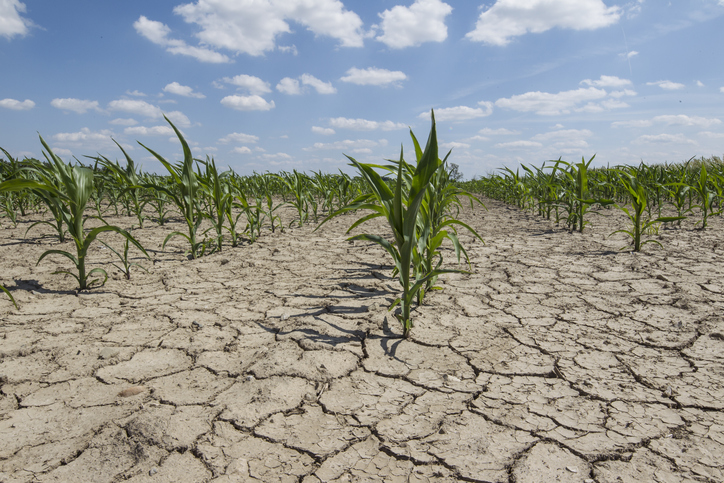
dry corn field with young corn plants
By Samira Adnan
For decades, farming in Kano State has sustained families and communities, but climate change, rising temperatures, and unpredictable rainfall are making agriculture and right to life increasingly difficult.
“I have been farming for 20 years,” said Sama’ila Abdul Kadir Dan Isa, a farmer in Rimin Gado Local Government Area “I used to grow cotton during the rainy season, but now I grow beans, maize, millet, and sometimes groundnuts, even last year, rainfall was enough, but yields were lower than before.”
Sama’ila emphasised early planting as critical. “If you plant late and the rains stop early, losses are inevitable,” he said.
Rising costs is also a factor, “I bought a bag of NPK fertiliser for ₦47,000. Previously, I farm from two hectares but had to reduce to one. Previously, I harvested 80 to 120 bags; but last year, only 20. It was a serious loss,” Sama’ila explained.
Access to improved seeds is also limitation. “No government agency, organisation or State Government has given us new seed varieties. We only hear about them on the radio,” he said. He then appealed to government for support adding that “If NPK were sold for ₦20,000 and urea for ₦18,000, farmers could produce enough food for homes and markets.”
Government and Experts Respond
Umar Sale Anka a Climate and agriculture expert warns that water scarcity is central to the crisis. “Water is running out in many communities, rainfall has dropped, temperatures have risen, our wells are drying up and people are digging boreholes everywhere, but when every household does it, the water table keeps falling.”
Anka advocated community-managed boreholes. “A single borehole serving an entire street is more sustainable. It eases the pressure on underground water,” he said.
Urban expansion is also disrupting natural water systems. “Along BUK Road, there used to be natural depressions where rainwater gathered. Now those areas are filled up and built upon. Water no longer has a place to settle,” he explained.
Experts are promoting Climate-Smart Agriculture (CSA) to help farmers adapt. CSA combines weather-informed planting schedules, drought-tolerant seeds, and organic soil restoration techniques.
“We work with NiMet’s seasonal forecasts. If rainfall will be low or delayed, we advise farmers to use early-maturing or drought-tolerant seeds,” Anka said. He stressed that restoring soil through organic composts, like decomposed animal waste, improves fertility and resilience against climate stress.
Environmental restoration is also key, Houses situated in areas like GRA, Audu Bako Secretariat, and the Emir’s Palace are visibly greener, cooler, and more biodiverse. “Tree planting protects the environment and is a form of continuous charity,” Anka said. The government provides seedlings, enforces tree-protection laws, and agencies like ACReSAL train farmers and communities on sustainable land management.
NGOs Promote Grassroots Adaptation
Non-governmental organisations are bridging gaps with practical solutions at the community level. The Arewa Women Initiative for Climate Change Advocacy (AWIFCA) has trained over 50 women farmers in climate-smart techniques, distributing drought-tolerant and heat-resistant seeds in partnership with the Ministry of Agriculture and Bayero University Kano’s Centre for Dryland Agriculture.
“These seeds can grow with minimal water and tolerate high temperatures, producing yields similar to rainy-season crops,” a programme coordinator said.
AWIFCA also promotes household gardening to improve nutrition and generate income. “Women can plant vegetables in sacks or backyards. It helps with food security and empowers them economically,” the coordinator explained.
Further programmes with IITA and ICRISAT introduced 25 native plant species, including tsamiya, magarya, and adu’a, which enrich soil and prevent erosion. “These plants strengthen the soil and protect against climate impacts,” she added.
A Way Forward
Experts agree that solving Kano’s agricultural challenges requires coordinated, integrated solutions:
- Regulated and community-managed groundwater systems
- Climate-informed seed distribution
- Soil restoration using organic methods
- Tree planting and environmental protection
- Affordable farm inputs
Without action, declining water tables and rising costs could worsen food insecurity. But with targeted investment, climate-smart practices, and grassroots support, farmers like Sama’ila are adapting and continuing to feed Kano and the nation.
This report was published with the support of HumAngle under SCOJA Fellowship.
About the Author