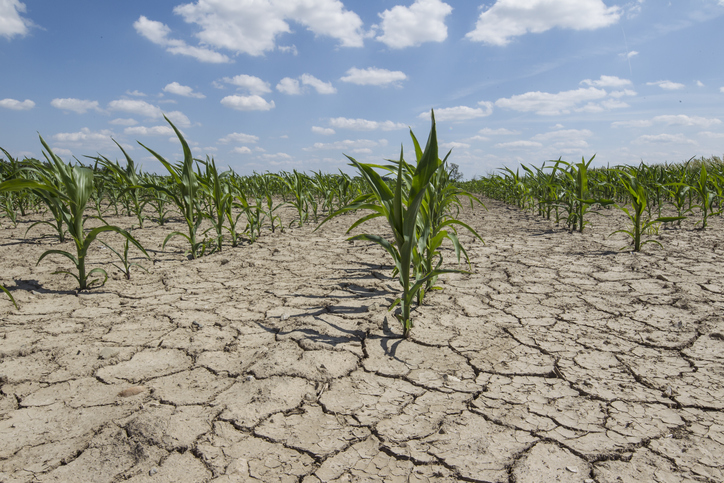
dry corn field with young corn plants
By Samira Adnan
For decades, farming has sustained families across Kano State. Today, many farmers say climate change, rising input costs and weak market systems are pushing them to the brink.
In Rimin Gado Local Government Area, Sama’ila Abdul Kadir Dan Isa reflects on two decades of farming experience marked by steady change.
“I have been farming for 20 years,” he said. “I used to grow cotton during the rainy season, but now I grow beans, maize, millet and sometimes groundnuts. Even last year, rainfall was enough, but yields were lower than before.”
He explained that timing has become critical. “If you plant late and the rains stop early, losses are inevitable,” he said.
Beyond erratic rainfall, rising production costs are compounding the crisis. “I bought a bag of NPK fertiliser for ₦47,000. I had to reduce my farm from two hectares to one. Previously, I harvested between 80 and 120 bags; last year, I harvested only 20. It was a serious loss,” Sama’ila said.
Access to improved seed varieties remains limited. “No government agency or organisation has given us new seeds. We only hear about them on the radio,” he said, appealing for support. “If NPK were sold for ₦20,000 and urea for ₦18,000, farmers could produce enough food for homes and markets.”
Tomato farmers in Karfi in Kura Local Government Area and Kwanar Gafan in Garun Malam Local Government tell a similar story. Despite recording bumper harvests this season, they say they suffered heavy losses due to high transportation costs and absence of storage and processing facilities.
Malam Hudu Shehu, a dry-season farmer in Karfi with over 40 years of experience, said he harvests about 40 baskets of tomatoes daily but is forced to dump a large portion.
“Sometimes we are left with no choice but to dispose of the tomatoes because they rot and smell. Whatever I sell cannot even cover transportation costs,” he said. He added that fertiliser now costs about ₦70,000 per bag, making production increasingly expensive.
Another farmer, Muhammad Audu, said some growers are drying tomatoes to minimise loss. He called for government intervention, particularly the revival of tomato processing factories. “If government can revive the tomato processing factory, it will encourage us to boost production,” he said.
Climate expert, Government Responds
Experts say water scarcity is central to the broader crisis. Umar Sale Anka, a climate and agriculture expert, warns that declining rainfall and rising temperatures are drying up wells across communities.
“Water is running out in many areas. Rainfall has dropped, temperatures have risen, and our wells are drying up. People are digging boreholes everywhere, but when every household does it, the water table keeps falling,” Anka said.
He advocates for community-managed water systems. “A single borehole serving an entire street is more sustainable. It eases the pressure on underground water,” he explained.
Urban expansion is also disrupting natural water recharge systems. “Along BUK Road in Kano, there used to be natural depressions where rainwater gathered. Now those areas are filled and built on. Water no longer has a place to settle,” he said.
To help farmers adapt, experts are promoting Climate-Smart Agriculture (CSA), which combines weather-informed planting schedules, drought-tolerant seeds and organic soil restoration techniques.
“We work with NiMet’s seasonal forecasts. If rainfall will be low or delayed, we advise farmers to use early-maturing or drought-tolerant seeds,” Anka said. He stressed that restoring soil with organic compost, such as decomposed animal waste, improves fertility and resilience.
Environmental restoration is also being encouraged. “Tree planting protects the environment and is a form of continuous charity,” Anka said, noting that greener neighbourhoods such as GRA, Audu Bako Secretariat and the Emir’s Palace demonstrate the cooling benefits of trees. He added that government agencies, including ACReSAL, are distributing seedlings and training communities on sustainable land management.
At the federal level, the government has begun distributing agricultural inputs to smallholder farmers in Kano to enhance year-round farming and food security. Representing the Minister of Agriculture and Food Security, Sen. Abubakar Kyari, Alhaji Yarima Uba, Director, Department of Horticulture, Federal Ministry of Agriculture and Food Security, said government has implemented several interventions, including economic reforms and emergency responses, to mitigate the country’s food crisis.
“It is the resolve of the present administration to attain the objectives of the Sustainable Development Goals, especially zero hunger, while also mitigating the food crisis in the country.
Items distributed include power tillers, herbicides, fertilisers, knapsack sprayers and water pumps. Beneficiaries include cooperative groups, commodity associations and persons with disabilities.
A beneficiary, Murtala Musa, commended the initiative. “We appreciate the government for including vulnerable farmers. We hope the support will continue,” he said.
Non Governmental Organisation’s Step In
Non-governmental organisations are also stepping in, The Arewa Women Initiative for Climate Change Advocacy (AWIFCA) has trained more than 50 women farmers in climate-smart techniques, distributing drought-tolerant and heat-resistant seeds in partnership with the Ministry of Agriculture and Bayero University Kano’s Centre for Dryland Agriculture.
“These seeds can grow with minimal water and tolerate high temperatures, producing yields similar to rainy-season crops,” said programme coordinator Alawiyya Baba.
AWIFCA also promotes household gardening to improve nutrition and income. “Women can plant vegetables in sacks or backyards. It helps with food security and empowers them economically,” she explained.
In collaboration with IITA and ICRISAT, the group has introduced 25 native plant species, including tsamiya, magarya and adu’a, to enrich soil and prevent erosion. “These plants strengthen the soil and protect against climate impacts,” she added.
The Special Agro-Industrial Processing Zones (SAPZ) initiative is supporting farmers in Bagwai Local Government Area with improved seeds, fertilisers and training. The Secretary General of beneficiary farmers, Isma’ila Iliyasu Wakili, said the programme has boosted yields and income, particularly in rice and tomato production.
However, he acknowledged ongoing challenges. “Tomatoes remain difficult because of pests known as ‘Sharon,’ limited markets and lack of processing facilities,” Wakili said, disclosing plans to establish a tomato processing plant in Bagwai to address up to 80 per cent of farmers’ challenges.
Human Rights and Legal Address
Human rights advocates warn that the crisis goes beyond economics. IHRC Country Director Abdullahi Bakoji said flooding, land degradation and climate disruptions are threatening farmers’ rights to food, income and dignity.
Legal practitioner Isa Abdul’aziz noted that while farmers are not specifically mentioned in the Constitution, Chapter IV guarantees rights to life, dignity, property and association. He added that Chapter II mandates the state to ensure adequate livelihood, social justice and environmental protection.
Experts agree that addressing Kano’s agricultural challenges will require coordinated action, including regulated and community-managed groundwater systems, climate-informed seed distribution, soil restoration, tree planting and affordable farm inputs.
Without decisive intervention, they warn, falling water tables and rising costs could deepen food insecurity. But with sustained investment and collaboration between farmers, government and civil society, many believe Kano’s agricultural sector can adapt and remain resilient.
This report was published with the support of HumAngle under SCOJA Fellowship
About the Author